
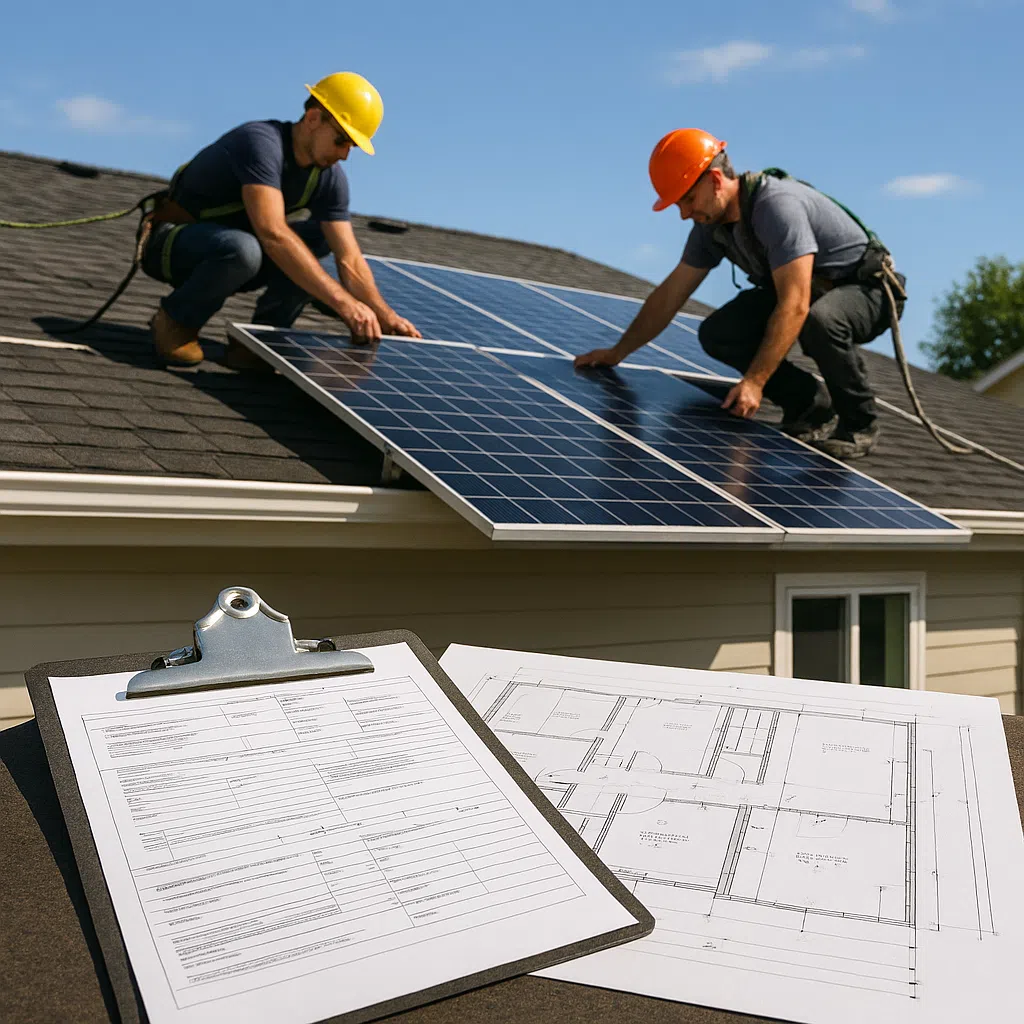
Solar Permit Plan Set Requirements by State: The 2026 Complete Guide
Everything solar installers, EPCs, and roofing contractors need to know about permit plan sets, AHJ requirements, NEC 2026 changes — and how to get your solar permit drawings approved faster in every state.

Solar permit drawings are the first thing an AHJ asks for — and the last thing most installers want to deal with.
Why Solar Permitting Got Harder in 2026
If your permit submissions are taking longer or coming back with more revision requests than they used to, you're not imagining it.
Three things changed around the same time, and the combination hit a lot of installers by surprise:
- NEC 2026 rolled out with real field-level changes to Article 690 — including a new rounding rule and stricter Isc calculations that catch plan sets which would have sailed through a year ago.
- FEOC compliance rules kicked in January 1, 2026. Commercial projects now need to verify equipment sourcing before design finalisation, or risk losing ITC tax credit eligibility.
- AHJ scrutiny tightened nationally as installation volumes hit record highs. More submissions means more reviewers, more inconsistency, and more flags on plan sets that aren't airtight.
Installers who understand exactly what each state requires — and who work with a solar permit design partner already versed in those requirements — are actually moving faster than ever. This guide gives you that understanding.
What Is a Solar Permit Plan Set?
A solar permit plan set is the complete package of technical drawings and documentation submitted to your local Authority Having Jurisdiction (AHJ) before installation can legally begin. No approved plan set, no install.
A standard residential solar permit plan set includes:
- Site plan showing the property, roof layout, and array placement
- Electrical single-line diagram covering all components, wire sizing, conduit runs, overcurrent protection, and rapid shutdown compliance
- Roof plan showing exact panel placement, fire setbacks, pathways, and attachment points
- Structural details including racking specs, roof penetration details, and load calculations
- Equipment specification sheets for modules, inverters, racking, and battery storage
- Electrical calculations covering string sizing, voltage/current, and NEC 2026-compliant conductor sizing
- Labels and placards for rapid shutdown, AC/DC disconnects, and interconnection points
Commercial solar permit drawings add interconnection diagrams, load calculations at service entrance, structural engineering stamps, and — in most states — a PE stamp from a licensed Professional Engineer.

A solar single-line diagram is a core component of every permit plan set — showing all system components, connections, and NEC 2026-compliant calculations.
NEC 2026 Changes Every Installer Should Know
The 2026 National Electrical Code brings specific changes to Article 690 (Solar Photovoltaic Systems) that affect how solar permit drawings are prepared. Here's what actually matters in the field:
Section 690.4(G) — The New Rounding Rule
NEC 2026 standardised the rounding rule for PV system calculations. Some designers previously rounded Isc values down to get more lenient conductor sizing — that flexibility is gone. NEC 2026 requires the highest Isc value from the datasheet, full stop.
In practice: expect slightly heavier conductor sizing on some systems, but significantly cleaner submittals with fewer revision cycles from AHJs who've updated their checklists.
Modelling Tools Now Open to Smaller Systems
Previously only systems over 100kW could use tools like SAM (System Advisor Model) for calculating PV source circuit currents. NEC 2026 removes that threshold entirely. Small and mid-sized commercial jobs now use the same streamlined calculation pathway — which means more consistent solar permit drawings and less friction during AHJ review.
FEOC Compliance Documentation — New in 2026
Starting January 1, 2026, commercial and industrial projects must source at least 40% of manufactured product value from non-FEOC (Foreign Entity of Concern) suppliers to qualify for ITC tax credits. That threshold rises 5% annually, hitting 60% by 2029. For batteries it starts at 55% this year.
Critical: FEOC verification must happen before design finalisation — not after. If your solar permit drawings reflect non-compliant equipment and you get AHJ approval, you still lose tax credit eligibility. Build FEOC manufacturer documentation into your pre-design checklist.
Top 10 States: Solar Permit Drawing Requirements at a Glance
These 10 states represent the vast majority of US solar installations. Here's what your solar permit drawings need to clear in each one:
| State | PE Stamp | Code Adopted | Avg. Approval | Key Notes |
|---|---|---|---|---|
| California | Required >10kW | Title 24 + NEC 2022 | 1–5 days | SolarAPP+ for qualifying systems |
| Texas | Varies by city | Local adoption varies | 1–3 weeks | No statewide framework — verify every AHJ |
| Florida | Required (all) | FBC + NEC 2020 | 2–4 weeks | Hurricane wind loads mandatory statewide |
| New York | Required >12kW | NEC 2020 | 3–6 weeks | NYC DOB has strictest requirements |
| New Jersey | Required | NEC 2020 | 2–4 weeks | High solar density — AHJs very experienced |
| Arizona | Rarely required | NEC 2017/2020 | 1–2 weeks | Fast, installer-friendly market |
| Colorado | Sometimes | NEC 2020 | 1–3 weeks | Snow load calculations essential |
| Massachusetts | Required | NEC 2020 | 3–5 weeks | Two-track interconnection process |
| North Carolina | Required | NEC 2020 | 2–3 weeks | Utility territory matters significantly |
| Georgia | Rarely required | NEC 2020 | 1–2 weeks | Growing market, streamlined process |
State-by-State Deep Dive
California
California is genuinely the most complex solar permit market in the country. It's also the biggest, so you can't avoid it. Since January 2020, most new residential construction requires solar under Title 24. The 2025 Title 24 standards took effect January 1, 2026.
- PE stamp required for structural plans on systems over 10kW; electrical PE required above 50kW
- Title 24 compliance documentation required for all new construction
- Seismic load calculations required per CBC and ASCE 7
- SB 379 mandates online automated permitting for cities over 50,000 population
- Fire setbacks: 3-foot pathways from roof edges (varies by AHJ)
Real talk: Use SolarAPP+ for residential systems under 10kW in participating jurisdictions — permits can issue in minutes. For larger systems, your solar permit drawings need to be watertight before submission.

California leads the US in solar capacity — and has some of the most detailed solar permit drawing requirements in the country.
Texas
Texas added more new solar capacity than any other state in 2024 — 11.6 GW. It's also one of the most inconsistent permitting environments because there's no statewide regulatory framework. What passes in Austin can get rejected in Houston.
- No statewide PE stamp requirement — varies dramatically by city and county
- Houston, Dallas, Austin: PE stamps typically required for commercial and systems over 10kW
- Coastal areas: hurricane zone structural requirements apply
- Rural Texas: some counties have minimal requirements; others add months
Real talk: If you're working across multiple Texas cities, keep a running AHJ requirements checklist. The variance is significant enough that it matters for every single job.
Florida
Florida ranks third nationally in solar generation but permitting is among the most demanding in the country. PE stamps aren't bureaucratic red tape here — they're genuine structural engineering for hurricane-prone regions.
- PE stamp mandatory on virtually all projects — structural PE is non-negotiable for wind load compliance
- Hurricane zone wind load calculations required statewide; coastal zones face additional scrutiny
- Miami-Dade and Broward (HVHZ): strictest requirements in the state
- State-mandated 60-day cap on permit processing
Real talk: Florida's rejection rate is significantly higher than most states for solar permit drawings without proper wind load calculations. Never submit without verified local wind speed data.
New York
New York has some of the tightest permitting requirements outside California — particularly in New York City, where the Department of Buildings oversees all submissions.
- NYC and most upstate jurisdictions: PE stamps required for most installations
- $2M liability insurance required for interconnection in NY
- PE-certified solar permit drawings required for systems exceeding 12kW
- Climate considerations: snow loads, ice dams, and wind exposure all factor in
Real talk: NYC submittals deserve extra attention. The DOB has specific formatting requirements for solar permit drawings that differ from what other AHJs accept.
Need Solar Permit Drawings Done Fast?
2,500+ AHJ-ready solar permit drawings delivered every month. Any state. Any AHJ. NEC 2026 compliant. Delivered in 24–48 hours.
Order Your Plan Set Now →Trusted by 150+ solar installers • US, UK & Australia • Free revisions until approved
Top 7 Reasons Solar Permit Applications Get Rejected
Based on processing 2,000–2,500 solar permit drawings every month, these are the issues that cause the most resubmissions:
- Inconsistent drawings. Discrepancies between the site plan and single-line diagram are the #1 cause of immediate rejection. Every element must cross-reference perfectly across all sheets.
- Wrong conductor or OCPD sizing. Mismatched wiring or overcurrent protection that doesn't meet NEC 690/705 — now more strictly enforced under NEC 2026 Section 690.4(G).
- Incomplete equipment spec sheets. Outdated or partial datasheets for modules, inverters, or racking. Always pull the current datasheet directly from the manufacturer.
- Fire access violations. Missing the 3-foot rooftop pathways and setbacks required by local fire codes. Requirements vary by AHJ — don't assume.
- No rapid shutdown detail. Missing a compliant rapid shutdown plan is an automatic flag for both residential and commercial permit sets.
- Vague or wrong labelling. Missing or incorrectly worded safety labels on electrical solar permit drawings. Every label must match the AHJ's accepted language exactly.
- Battery storage oversights. Forgetting clearance, ventilation, or disconnect requirements when adding energy storage — especially for DC-coupled systems.

An approved solar permit plan set — the result of accurate drawings, correct calculations, and AHJ-specific compliance built in from the start.
How Permit Design Handles This For You
Permit Design produces solar permit drawings for 150+ solar installers, EPCs, and roofing companies across the US, UK, Australia, and Europe — 2,000–2,500 AHJ-ready solar permit drawings every month.
Here's what that means for you in practice:
- NEC 2026 from day one. Every solar permit drawing we deliver is fully current with NEC 2026 — including Section 690.4(G) rounding rules. No catching up, no revision cycles from outdated standards.
- All 50 states covered. We maintain active knowledge of AHJ requirements across hundreds of US jurisdictions. You don't need to research each city's quirks before every job — we already know them.
- 24–48 hour turnaround. Completed solar permit drawings delivered within 24–48 hours of receiving your project details. Rush delivery available.
- Every service type. Residential solar, commercial solar, EV charging, battery backup, generator, and ground mount — all from one partner.
- Competitive pricing. We consistently beat existing vendor pricing. Contact us for a quote tailored to your volume.
See our solar permit drawings service page for full details on what's included in every plan set.
Need Solar Permit Drawings Done Fast?
2,500+ AHJ-ready solar permit drawings delivered every month. Any state. Any AHJ. NEC 2026 compliant. Delivered in 24–48 hours.
Order Your Plan Set Now →Trusted by 150+ solar installers • US, UK & Australia • Free revisions until approved
Frequently Asked Questions
How long does it take to get a solar permit approved?
It depends on the state and AHJ. Automated platforms in California can issue permits in minutes for qualifying systems. Most jurisdictions take 1–4 weeks. Complex commercial projects in high-scrutiny markets like NYC or Florida can take 4–6 weeks. Having complete, accurate solar permit drawings from the start is the single biggest factor in reducing that timeline.
What's the difference between solar permit drawings and a PE stamp?
Solar permit drawings are the full set of technical documents submitted to the AHJ. A PE stamp is a licensed Professional Engineer's certification added to certain sheets, confirming they meet structural or electrical engineering standards. Some states require PE stamps on solar permit drawings; others don't. Requirements vary by state, system size, and AHJ.
How much do solar permit drawings cost?
Costs vary by project complexity, location, and whether PE stamps are required. Residential solar permit drawings are typically less expensive than commercial. PE stamps add cost — typically $200–$650 per project depending on state and type. Contact Permit Design for pricing tailored to your project volume — we consistently beat what installers are currently paying.
Can I use the same solar permit drawings for multiple AHJs?
No. AHJ requirements vary significantly — even within the same state. Solar permit drawings must be tailored to each jurisdiction's specific code adoptions, labelling requirements, and submission format. What works in one city may be rejected outright in the next.
What happens if my solar permit drawings get rejected?
Most rejections are for fixable technical issues — missing labels, outdated equipment sheets, or minor calculation discrepancies. A good solar permit design partner handles revision turnarounds quickly. At Permit Design, revisions are part of the service — we handle them until your AHJ is satisfied.
Are your solar permit drawings NEC 2026 compliant?
Yes. Every solar permit drawing we produce is fully compliant with NEC 2026, including the updated Section 690.4(G) rounding rules and revised Isc calculation requirements. We track every NEC code cycle so your plan sets are always submitted to the current standard — whether that's NEC 2020, 2022, or 2026.
0 Comments